
Build Skills and Plan Your Career
The Skills Framework for Sea Transport outlines maritime roles, career pathways, skills and training opportunities.
Use the framework to:
- Explore roles and career pathways.
- Identify required and emerging skills.
- Find relevant training.
Mid-careerists can use it to assess transferable skills and identify gaps to address.
Explore the Skills Framework for Sea Transport
The Skills Framework for Sea Transport was jointly developed by Skills and Workforce Development Agency (SWDA) and Maritime and Port Authority of Singapore (MPA), with full consultations with employers, industry associations and education and training providers, as well as support from the labour movement. It provides useful information on:
- Career pathways;
- Occupations and job roles;
- Existing and emerging skills; and
- Training programmes for skills upgrading and mastery
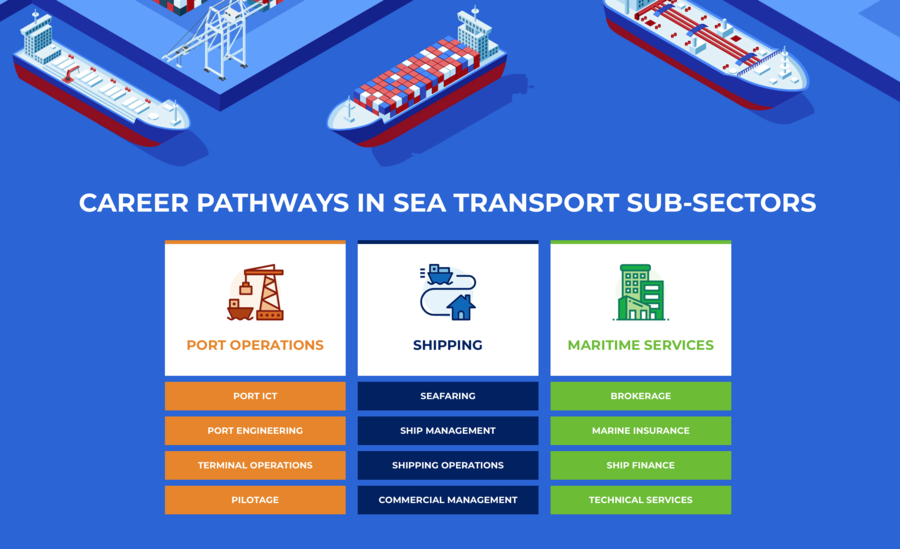
Individuals who are keen to know more about the diverse career pathways in the Sea Transport sector, or plan for your progression within the sector, can use this Skills Framework to assess career interests, identify relevant skills to develop, and prepare for desired job roles. This Skills Framework can also help Sea Transport employers recognise these relevant skills, and invest in training employees for career development and skills upgrading.
Navigate Skills Framework for Sea Transport
More information can also be found on SkillsFuture.sg.
Education for Shore-based Maritime Careers
Students who are interested in developing specialised maritime knowledge can pursue maritime-related programmes offered by Singapore’s Institutes of Higher Learnings (IHLs). Maritime-related education and training pathways are available at different levels, including programmes offered by Institutes of Technical Education (ITE), Polytechnics, and Universities.
Maritime Singapore is evolving with advances in digitalisation, automation and artificial intelligence, as well as the transition towards more sustainable shipping. These developments are creating demand for professionals who can combine strong domain knowledge with capabilities in areas of data and AI, cybersecurity, automation, sustainability and decarbonisation. Students from interdisciplinary courses who are interested in maritime careers can therefore build relevant skills through projects, electives, maritime minors and specialisations.
Mid-career professionals who are interested to make a transition into the sector can also choose from a range of Continuous Education and Training (CET) programmes, from short courses to professional certifications to postgraduate programmes, offered by both IHLs and Training Providers.
Explore maritime-related programmes offered by Singapore’s IHLs here.
Explore short-based training at Training@MaritimeSingapore or MySkillsFuture.
Education for Seafaring Maritime Careers
Students who are interested in pursuing a career at sea can undertake specialised maritime education and training that prepares them for professional seafaring roles. In Singapore, the Singapore Maritime Academy at Singapore Polytechnic offers the Diploma in Nautical Studies and Diploma in Marine Engineering, which provide pathways towards careers as deck and marine engineer officers respectively.
Mid-career professionals who are interested in making a transition to a seafaring career can consider the Tripartite Maritime Training Award programme offered by Wavelink Maritime Institute. The train-and-place programme provides an alternative pathway for individuals without prior maritime experience to undergo structured training and gain the necessary sea-going experience towards becoming qualified seafarers.
Explore maritime education and training programmes for seafaring careers offered by Singapore Maritime Academy and Wavelink Maritime Institute.
Training for Shore-based Maritime Careers
Institutes of Higher Learning and other providers offer short courses, certifications, diplomas and postgraduate programmes for shore-based roles.
Employers may also provide on-the-job or in-house training for specific roles and operational needs.
Relevant capability areas include:
- Shipping and maritime business
- Port and maritime operations
- Digitalisation, data and AI
- Sustainability and decarbonisation
- Cybersecurity
Explore shore-based training at Training@MaritimeSingapore or MySkillsFuture.
Seafaring Training and Certification
Seafarers need the required training, certification and competence before serving onboard. MPA oversees these requirements in Singapore.
Discover the Sail Milestone Achievement Programme (SAILMAP) here.
Find information on the following at Singapore Maritime Academy and Wavelink Maritime Institute:
- Certificates, endorsements and revalidation
- Eligibility and assessments for deck and marine engineer officers
- Approved training and providers
- Online applications and certificate authentication